
Shame & Self-Criticism
Shame and self-criticism are the harsh inner voice and the deep sense of being flawed or “not good enough” that often sit underneath anxiety, perfectionism, and low mood.
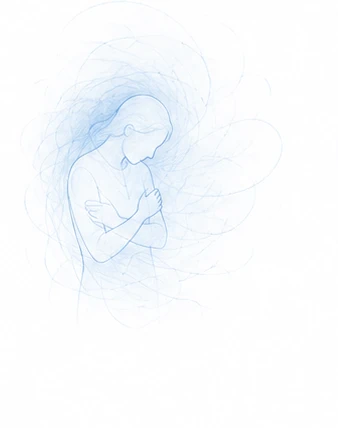
How it can show up
- A relentless inner critic that attacks you over mistakes
- A deep feeling of being flawed, inadequate, or unlovable
- Comparing yourself unfavourably to others
- Difficulty accepting compliments, kindness, or your own successes
- Hiding parts of yourself for fear of being “found out”
What are shame and self-criticism?
Shame is the painful sense that something is wrong with us, not just with what we did. Self-criticism is the harsh, often automatic inner voice that polices us. Both are common human experiences, but when they run high they fuel anxiety and depression and make everything harder.
Why the inner critic is so sticky
High self-criticism is a transdiagnostic risk factor linked to the development and persistence of depression and anxiety (Blatt, 1995). Compassion-Focused Therapy (Gilbert) frames it through the brain’s threat, drive, and soothing systems: when the threat system dominates, self-criticism feels protective but keeps you stuck in fear and shame, while the soothing system stays underdeveloped.
How therapy helps
Compassion-Focused Therapy was developed specifically for people with high shame and self-criticism, and compassion-based practices have been shown to reduce both (Gilbert & Procter, 2006). We work to understand the critic’s origins, deliberately strengthen your capacity for self-compassion, and help you meet yourself with the steadiness you’d offer someone you love — which, research shows, increases resilience and motivation rather than lowering your standards.
How the Unified Protocol helps with shame and self-criticism
Shame and self-criticism maintain themselves through a pattern of emotional avoidance — hiding, withdrawing, over-accommodating, and suppressing uncomfortable feelings about the self. These are exactly the emotion-driven behaviours the UP was built to address. Rather than directly attacking the critical thoughts, the UP works by changing your relationship with difficult emotions so the self-protective behaviours gradually become unnecessary.
A case from the borderline personality disorder chapter in Barlow & Farchione (2018) illustrates the pattern well. The patient had deep fears of abandonment and rejection that led to suppressing her own opinions and needs in relationships. A central treatment goal was learning that expressing a differing view does not have to lead to conflict or loss — and gradually testing this through direct, values-guided action rather than avoidance.
Case example from Barlow & Farchione (2018) — Applications of the Unified ProtocolImportantly, the UP reduces neuroticism — the underlying temperament that amplifies shame sensitivity and self-critical reactivity — as a direct effect of treatment (Carl et al., 2014). This suggests the UP does not just reduce symptoms but shifts the emotional foundation that makes shame so difficult to move past.
For younger clients: The UP for Adolescents (UP-A; Ehrenreich-May et al., 2017) addresses shame-related avoidance and self-critical patterns in teenagers. An open trial by Bilek & Ehrenreich-May (2012) found significant reductions in depression and anxiety in adolescents with comorbid emotional difficulties — many of whom presented with high self-criticism and shame as a central feature.
Frequently asked questions
Isn’t my inner critic what keeps me successful?
Many people fear that, but research shows self-criticism tends to undermine resilience and motivation, while self-compassion supports both. You can keep high standards and accountability without the self-attack.
What therapy is best for shame and self-criticism?
Compassion-Focused Therapy (CFT) was developed specifically for high shame and self-criticism and has evidence for reducing both. It is often combined with ACT and CBT approaches.
Is self-compassion just self-indulgence?
No. Self-compassion means meeting yourself with honesty and steadiness, not lowering your standards. It is associated with greater motivation, resilience, and follow-through.
Free self-help resources
Evidence-based CBT workbooks from the Centre for Clinical Interventions (Government of Western Australia) — a helpful complement to therapy you can start on your own:
- Building Self-Compassion — Understanding Self-Compassion An introduction to self-compassion and how to build it.
- Improving Self-Esteem — What is Low Self-Esteem? A CBT workbook for understanding and improving low self-esteem.
- Caring Less About Your Looks — The Impact of Appearance Overconcern A CBT workbook for easing appearance-related self-criticism.
Try it yourself
Selected clinical references
The approach to this concern is informed by established clinical models and treatment guidelines, including:
- Gilbert, P. (2009). The Compassionate Mind: A New Approach to Life’s Challenges.
- Gilbert, P., & Procter, S. (2006). Compassionate mind training for people with high shame and self-criticism.
- Blatt, S. J. (1995). The destructiveness of perfectionism: Implications for the treatment of depression.
- Farchione, T. J., et al. (2012). Unified Protocol for Transdiagnostic Treatment of Emotional Disorders: A Randomized Controlled Trial. Behavior Therapy, 43(3), 666–678.
- Barlow, D. H., et al. (2017). A unified protocol for transdiagnostic treatment of emotional disorders: A randomized controlled trial. JAMA Psychiatry, 74(9), 875-884.
- Barlow, D. H., & Farchione, T. J. (Eds.). (2018). Applications of the Unified Protocol for Transdiagnostic Treatment of Emotional Disorders. Oxford University Press.
- Bilek, E. L., & Ehrenreich-May, J. (2012). An open trial investigation of a transdiagnostic group treatment for children with anxiety and depressive symptoms. Behavior Therapy, 43(4), 887-897.
- Carl, J. R., Gallagher, M. W., Sauer-Zavala, S., Bentley, K. H., & Barlow, D. H. (2014). A preliminary investigation of the effects of the Unified Protocol on temperament. Comprehensive Psychiatry, 55(6), 1426-1434.